Choose a site
Connect safe access and water conditions with the survey question.
EXPLORE · SAMPLE · DISCOVER
Introduce biodiversity monitoring with River Detectives: a free eDNA sampling game, a 30–40 minute lesson and a printable student worksheet.
PLAY RIVER DETECTIVES →OPEN TEACHER ACTIVITY →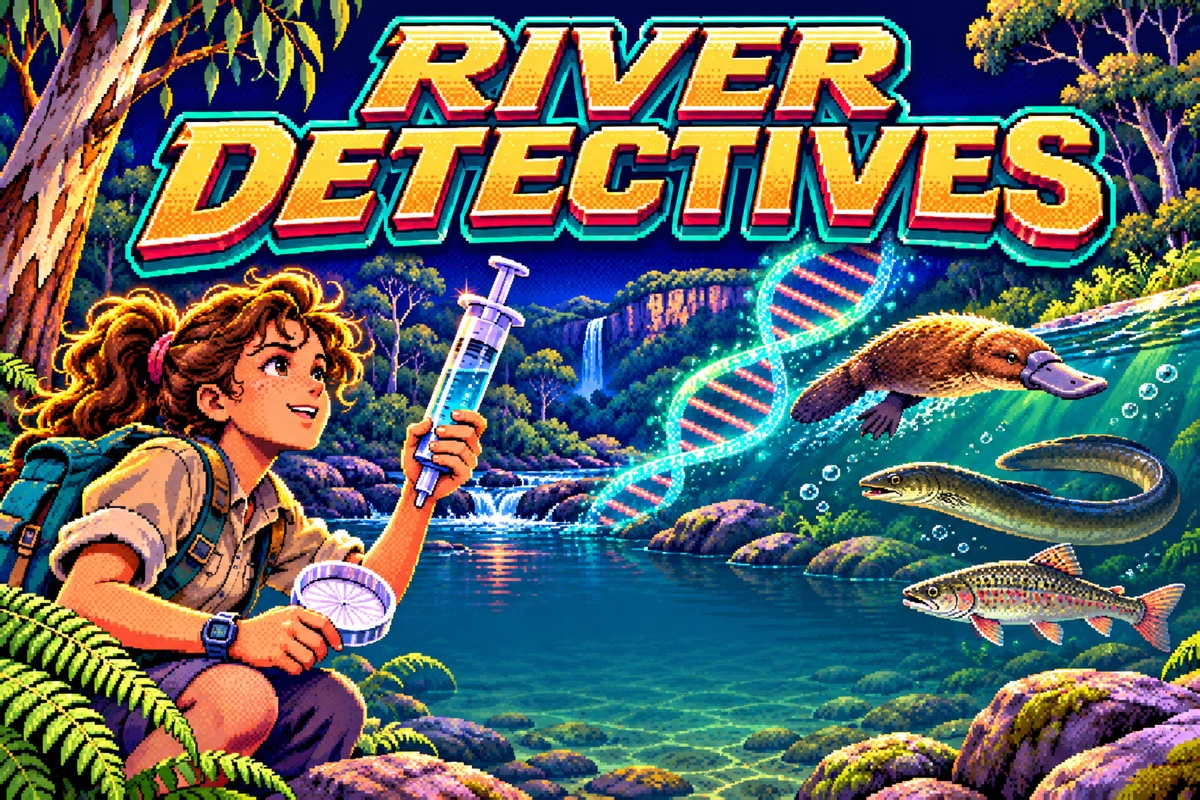
Suggested learners: ages 9–14 with adult support as needed · Lesson: 30–40 minutes · Access: free browser game, no account required. Adapt to your learners; no formal curriculum alignment claimed.
Environmental DNA (eDNA) is genetic material organisms leave in their surroundings. Water samples can contain traces from organisms that live in or use a waterway. Laboratory analysis can help investigate biodiversity without requiring every animal to be seen.
An eDNA detection is evidence of DNA in a sample. It does not by itself give an animal count or exact location. A non-detection does not prove a species is absent.
Choose one of seven Victorian river areas or an ocean expedition off Cape Otway. Explore a top-down landscape, inspect suitable and unsuitable sites, prepare clean equipment, push water through a filter and interpret a simulated wildlife report.
Connect safe access and water conditions with the survey question.
Identify kit parts, limit contamination and record filtered volume.
Distinguish a DNA detection from a wildlife census.
For practice, players push four 50 mL fills through one filter: 200 mL total. This is one shortened game sample, not a universal field target. The real project plan sets replicate numbers, volumes and controls. Marine sampling also needs a laboratory-approved plan.
START THE eDNA GAME →There is no universal answer for all surveys. The game links the chosen kit’s instructions and explains its shortened practice volume. A real sampling plan specifies replicate numbers, volumes, controls and preservation.
No. They are regional teaching examples, clearly marked simulated. The linked Victorian survey explorer provides real inland results for comparison; the Cape Otway ocean mission is a fictional marine extension.
No. The classroom activity uses the game, paper and discussion. Students can learn the reasoning before considering a supervised field project.
The game’s results cannot. A detection supports the presence of DNA, while abundance claims require additional validated methods and interpretation.
Sources checked 3 November 2026. This is introductory education, not a complete field protocol. Real work uses the laboratory’s current kit instructions and project sampling plan. No endorsement by the cited organisations is implied.