PLANT · GROW · EXPLORE
Kelp forest restoration games & teaching resources
Explore giant kelp habitat and restoration with Giant Kelp Quest. Pair the free browser game with discussion, a printable student worksheet and teacher notes.
PLAY GIANT KELP QUEST →WORKSHEET + TEACHER NOTES →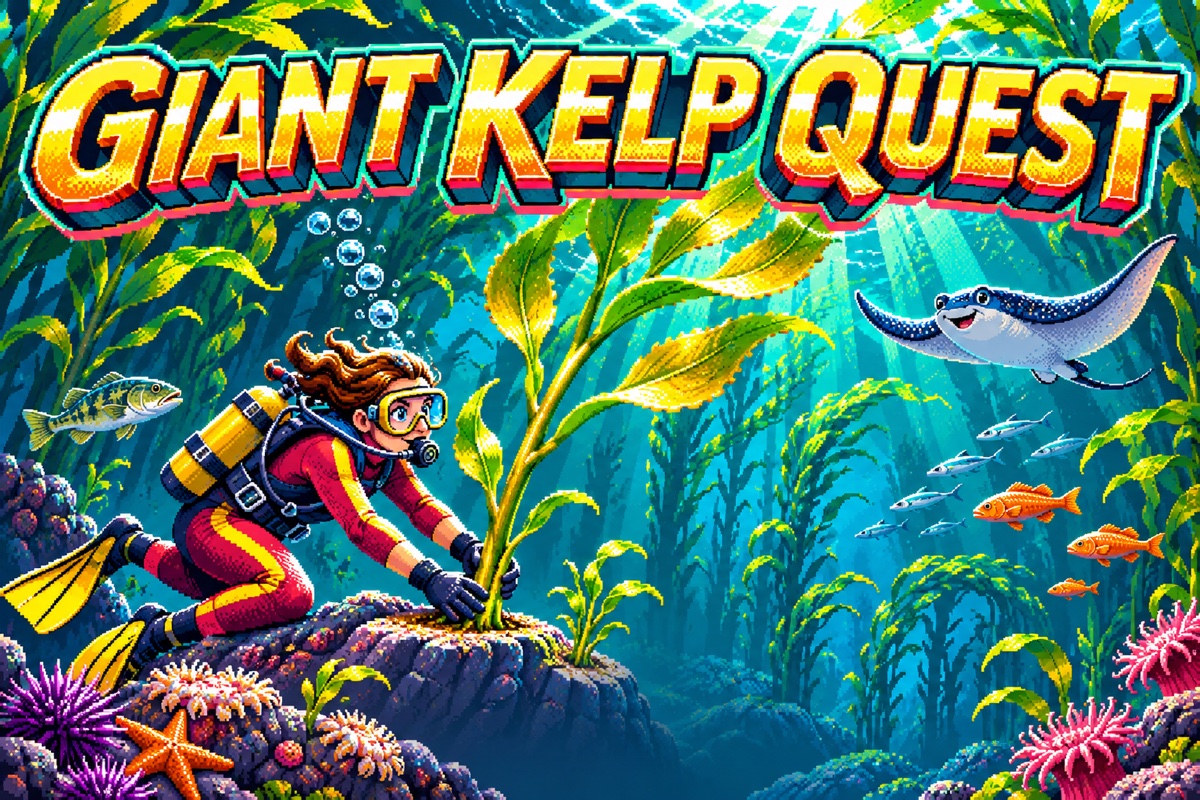
Suggested learners: ages 9–14 · Lesson: 30–40 minutes · Materials: browser device, paper and pencil. Free to play; no student account required. Adapt for your class; no formal curriculum alignment claimed.
What makes a kelp forest?
Giant kelp is a large brown seaweed. Its three-dimensional growth creates underwater habitat for fish and invertebrates. A kelp forest is a community of living things, rather than simply a collection of planted kelp.
Why does restoration need more than planting?
Suitable water conditions, a place to attach and pressures such as grazing affect recovery. Warming waters and changes in nutrient supply have contributed to giant kelp losses in Tasmania. Restoration trials combine growing young kelp with work to understand where it can survive.
What students do in Giant Kelp Quest
Swim to the rocky seabed, plant kelp on bare rocks and observe the simplified forest and arriving wildlife. Grow 10 plants to reach a game milestone; planting all 14 unlocks the game’s survey feature. Use the arrows or WASD to swim and space to plant, or the on-screen controls.
Game and real world: The 20-metre dive, rapid growth and animal arrivals are game settings. They are not a planting-depth recommendation, a recovery timetable or a prediction that particular animals will return.
A 30–40 minute classroom lesson
- Discuss — 5 minutes: How could losing an underwater forest affect the animals that use it?
- Play — 10–15 minutes: Work in pairs. Take turns controlling the game and observing decisions.
- Record — 10 minutes: Record a planting decision, one wildlife observation and what the game leaves out. Complete the worksheet.
- Reflect — 5–10 minutes: Would seeing an animal once prove the forest has recovered? What would you measure again?
Learning outcomes
- Explain how kelp creates habitat for other organisms.
- Connect attachment surfaces and water conditions with restoration decisions.
- Distinguish an arcade milestone from ecological evidence of recovery.
- Propose repeated observations to track kelp survival and habitat use.
Classroom questions
Is giant kelp a tree?
No. It is a brown seaweed. “Underwater forest” describes the habitat its growth creates.
Does the game show real recovery speeds?
No. Growth and wildlife arrivals are accelerated. Field restoration needs longer-term measurements and suitable local conditions.
Can students use this for a classroom project?
Yes. Use the browser game, the lesson below and the printable worksheet. The activity uses observation and reasoning; no diving or field planting is required.
Key vocabulary
- Habitat
- The place and conditions that an organism uses to live.
- Holdfast
- The structure that anchors a kelp to a surface.
- Restoration
- Work to help an ecosystem recover after damage.
- Monitoring
- Repeated observations used to investigate change.
Sources and further learning
- University of Tasmania: giant kelp restoration research
- Australian Government: Giant Kelp Ecological Community
Sources checked 3 November 2026. Game rules are drawn from the current Wild Arcade game. Classroom activities are original teaching examples, not field instructions. Cited research organisations have not endorsed these resources.