LOWER · TIME · LAND
Marine habitat deployment games & teaching resources
Explore marine habitat deployment with Mission: Deep Drop. Combine the free winch-control game with depth maths, discussion of seabed habitats and a printable classroom worksheet.
PLAY MISSION: DEEP DROP →WORKSHEET + TEACHER NOTES →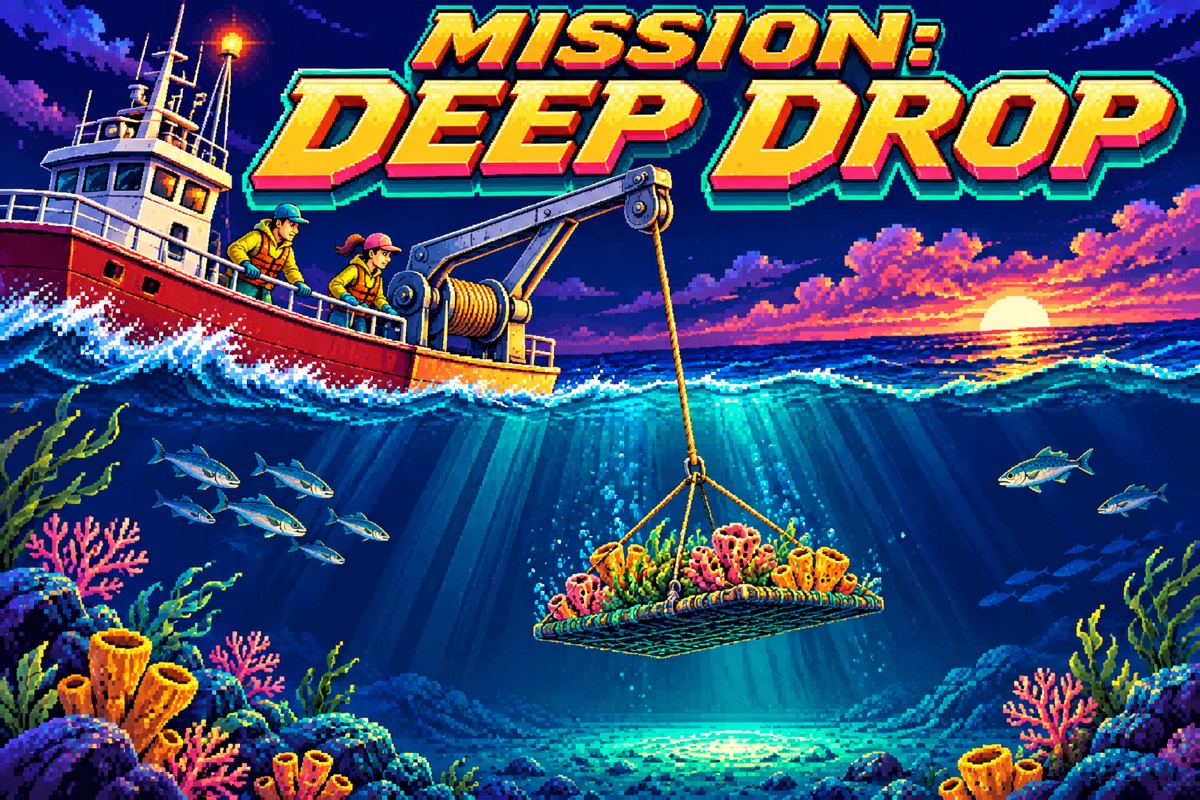
Suggested learners: ages 9–14 · Lesson: 30–40 minutes · Materials: browser device, paper and pencil. Free to play; no student account required. Adapt for your class; no formal curriculum alignment claimed.
Why investigate the seabed first?
A habitat installation needs a reason for being placed at a particular site. Existing habitats, seabed conditions and the project’s aims matter. Apollo Marine Park includes rocky reefs and sediment habitats; some reef areas support sponge gardens. A sandy area can also support valuable wildlife.
How do teams learn what is underwater?
Marine researchers use tools such as underwater drones and cameras to investigate seafloor habitats and wildlife. Baseline information helps a project plan where to work and what to monitor afterwards. A depth reading alone does not describe the habitat below.
What students do in Mission: Deep Drop
Start the winch and stop the descent in the game’s 79.50–80.50 metre landing window. You can tap to start and tap again to stop, or hold and release. Auto stop is available for practice. Record several attempts and compare your depth readings.
Game and real world: The 80-metre target and one-metre landing window are arcade settings, not safe operating limits or a recommendation for real equipment. Real deployments require a site-specific engineered plan and trained crew.
A 30–40 minute classroom lesson
- Discuss — 5 minutes: What would you need to know before lowering a habitat mat from a boat?
- Play — 10–15 minutes: Work in pairs. Take turns controlling the game and observing decisions.
- Record — 10 minutes: Record three landing depths and compare them with the target window. Complete the worksheet.
- Reflect — 5–10 minutes: Does a precise landing prove the site was suitable or the habitat has recovered?
Learning outcomes
- Read decimal depth values and compare them with a target range.
- Calculate depth error and reflect on repeat attempts.
- Explain why depth control and habitat suitability are different questions.
- Propose baseline and follow-up observations for a marine restoration project.
Classroom questions
Why does the game use 80 metres?
It is the target chosen for this simplified Apollo-themed mission. It is not a universal restoration depth.
Does a successful landing mean restoration worked?
No. It shows you met the game’s depth target. Real success also needs suitable placement and evidence about ecological outcomes over time.
Can this activity teach real winch operation?
It introduces measurement and decision-making. Its controls and feedback are an arcade model; it is not operational training.
Key vocabulary
- Depth
- Distance below the water surface, expressed in metres here.
- Target range
- The interval accepted by the game for a landing.
- Baseline
- Measurements collected before an intervention for later comparison.
- Deployment
- Placing equipment or a structure at its planned location.
Sources and further learning
Sources checked 3 November 2026. Game rules are drawn from the current Wild Arcade game. Classroom activities are original teaching examples, not field instructions. Cited research organisations have not endorsed these resources.