FRAGMENT · ATTACH · RESTORE
Sponge restoration games & teaching resources
Discover marine sponges with Sponge Builders. Use the free game to introduce fragmentation, attachment and habitat placement, then investigate how a restoration trial could be monitored.
PLAY SPONGE BUILDERS →WORKSHEET + TEACHER NOTES →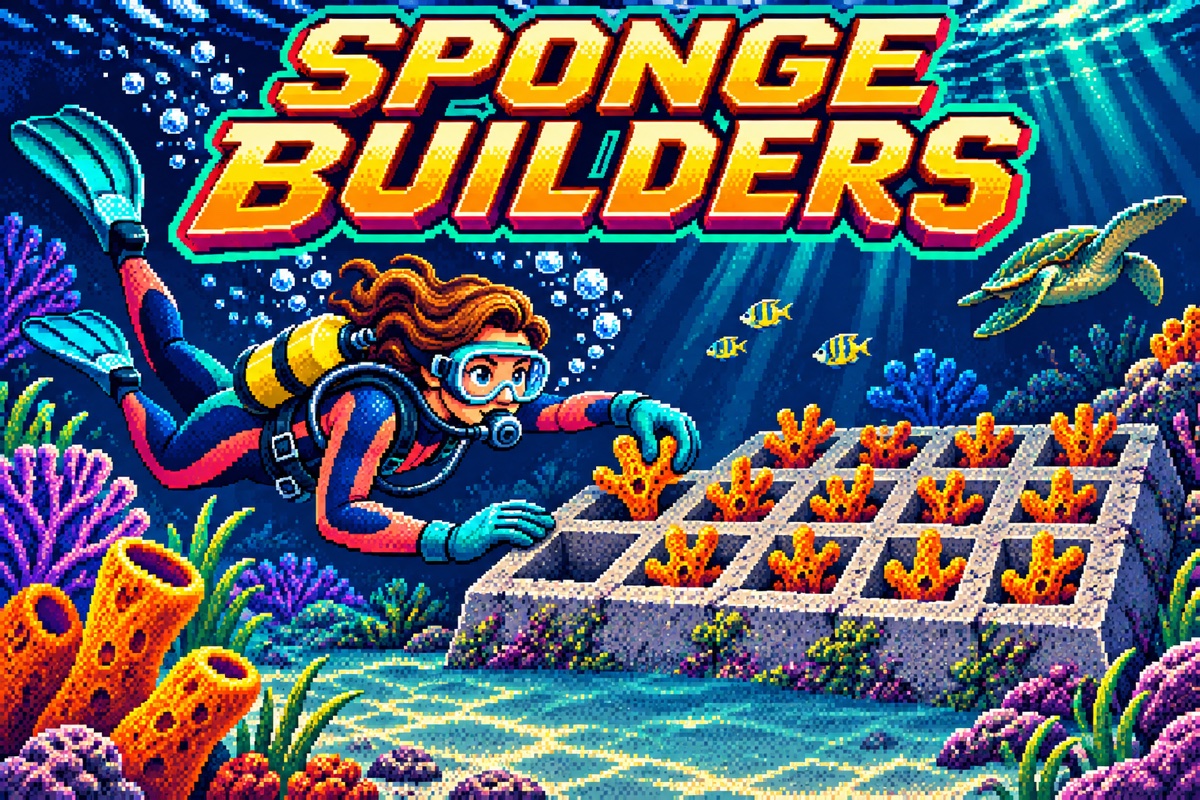
Suggested learners: ages 9–14 · Lesson: 30–40 minutes · Materials: browser device, paper and pencil. Free to play; no student account required. Adapt for your class; no formal curriculum alignment claimed.
What is a marine sponge?
Sponges are animals. Adult marine sponges usually remain attached to a surface, taking food from water moving through their bodies. Their structures can also provide habitat for small animals such as crabs and brittle stars.
What does fragmentation mean in this activity?
The game models dividing a sponge into fragments and attaching them to a habitat mat. It introduces a propagation idea, rather than a recipe for handling real sponges. Species, fragment condition, attachment methods and site conditions need investigation; growth and survival are not guaranteed.
What students do in Sponge Builders
Make 18 game fragments, attach a piece to each available habitat block, then lower and guide the EcoMat into place. Discuss why living material needs an attachment surface and why positioning matters.
Game and real world: The 18 fragments, click-to-attach steps and placement feedback are simplified game rules. They do not specify a real fragment size, adhesive, handling method or deployment design.
A 30–40 minute classroom lesson
- Discuss — 5 minutes: How can an animal that stays attached to a surface obtain food?
- Play — 10–15 minutes: Work in pairs. Take turns controlling the game and observing decisions.
- Record — 10 minutes: Record the preparation sequence, a placement decision and a possible reason a fragment might not survive. Complete the worksheet.
- Reflect — 5–10 minutes: Would attaching every fragment prove success? How would a comparison mat help?
Learning outcomes
- Identify sponges as animals and explain filter feeding.
- Describe the game sequence: fragment, attach, lower and position.
- Separate the number attached from the number surviving later.
- Suggest a comparison and repeated measurements for a restoration trial.
Classroom questions
Are sponges plants or corals?
Sponges are animals in their own group. They are not plants, and they are not corals.
Does every fragment grow into a new sponge?
The game simplifies this process. In a real project, outcomes depend on the species, handling, attachment and conditions, and need monitoring.
Do students need to collect or cut sponges?
No. This lesson uses the game and paper. Real collection, propagation and deployment belong within an approved project run by appropriately trained people.
Key vocabulary
- Fragment
- A piece of an organism; here, a small sponge piece in the game.
- Substrate
- The surface an organism attaches to or grows on.
- Filter feeding
- Obtaining food particles from passing water.
- Comparison
- A planned reference used to help interpret a result.
Sources and further learning
Sources checked 3 November 2026. Game rules are drawn from the current Wild Arcade game. Classroom activities are original teaching examples, not field instructions. Cited research organisations have not endorsed these resources.